When I started my Ottawa kitchen renovation, I didn’t expect the biggest challenge to be colour balance. I assumed choosing cabinets and countertops would be simple: find what I like, match a few tones, and move on. But the deeper I got into the design process, the more I realized how complex it actually was.
My goal was clear — I wanted warm cabinets that brought comfort and personality into the kitchen, but I also wanted the clean sophistication of cool-toned quartz countertops. I wanted contrast, but not conflict. I wanted warmth, but not heaviness. I wanted the modern feel of quartz without making the space feel cold.
Achieving that balance was far more delicate than I expected.
The process taught me how profoundly cabinet and countertop colours influence each other, how undertones impact the mood of a kitchen, and how important it is to test combinations in real lighting — especially in an Ottawa home, where light changes dramatically throughout the day.
This is the complete story of how I achieved the perfect balance between warm cabinets and cool quartz — and how it transformed my kitchen into the most harmonious and welcoming room in my home.
The First Problem: My Old Kitchen Had Too Much Warmth and Not Enough Balance
The Cabinets Were Warm, But Overwhelming
My old kitchen had warm-toned cabinets, but they weren’t the good kind of warm. They were slightly orange, heavily reflective, and mismatched with the flooring. Instead of adding comfort, they made the space feel dated. Worse, the warmth wasn’t balanced by anything else in the room.
The Countertops Added to the Problem
My previous countertops were a dark, warm, brownish tone that amplified the cabinets’ warmth instead of complementing it. The result?
- The kitchen felt heavy
- Shadows looked darker
- The cabinets appeared more orange
- The space felt dated and cramped
No matter how much I cleaned or decorated, the room always looked tired.
Lighting Exposed the Undertone Clash Even More
My Ottawa home gets a mix of warm morning light and cool natural afternoon light. The cabinets reacted differently under both conditions, while the old countertops reacted differently still.
The undertone mismatch became more obvious every day.
The Turning Point: Realizing I Needed Contrast, Not More Warmth
The biggest shift in my renovation mindset was understanding that contrast is what creates visual balance — not similarity.
Warm cabinets need something cool beside them to stay grounded.
Cool quartz needs something warm next to it to prevent sterility.
Once I realized this, my design decisions became much more intentional.
Step 1: Choosing Warm Cabinets Without Overheating the Space
Finding the Right Kind of Warmth
Warm cabinetry can mean many things:
- Golden warmth
- Red warmth
- Greige warmth
- Beige warmth
- Natural wood warmth
I didn’t want a reddish tone or anything too yellow. I wanted warmth that felt modern, soft, and timeless — not reminiscent of older builder-grade kitchens.
I chose a muted warm-neutral cabinet colour with:
- Matte finish
- Subtle beige undertone
- Soft grain pattern
- Enough warmth to feel inviting
- Enough neutrality to pair with cool surfaces
This became the foundation of the entire design.
Testing the Cabinets in Ottawa Lighting
Ottawa lighting changes dramatically throughout the day depending on the season. In winter, natural light can be cool. In summer, evening sunlight can be warm.
I tested the cabinet sample under:
- Direct morning sunlight
- Afternoon indirect light
- Evening warm LED lighting
- Overhead pot lights
This proved essential — some warm finishes looked perfect at noon but muddy at 8 AM.
The cabinet colour I chose stayed consistent in every scenario.
Step 2: Selecting the Cool Quartz That Balanced the Warm Cabinets
Why Cool Quartz Was the Right Choice
Warm cabinets paired with warm countertops would have suffocated the design. I needed cool quartz to:
- Brighten the kitchen
- Break up the warmth
- Add visual structure
- Modernize the space
- Reflect light more effectively
Cool-toned quartz gave me the clean, refreshing contrast the kitchen desperately needed.
Identifying the Right Undertone for the Quartz
Cool quartz also has variations:
- Blue undertone
- Blue-grey undertone
- True grey undertone
- Neutral-cool white undertone
A strong blue undertone would clash with my warm cabinets.
I needed something more neutral.
The quartz I chose had:
- A soft white base
- Very subtle cool veining
- A neutral-grey undertone
- A polished finish
It was cool — but not icy.
Modern — but not sterile.
Bright — but not harsh.
Seeing Quartz in the Actual Kitchen Made All the Difference
Quartz behaves differently in different lighting conditions. When I placed the full-size slab sample next to my cabinet sample in my Ottawa kitchen, I finally understood how perfect the combination was.
The quartz neutralized the cabinet warmth.
The cabinets softened the quartz coolness.
Together, they created harmony.
Step 3: Building a Layout That Enhanced the Warm–Cool Contrast
I Used Quartz Strategically for Maximum Impact
Quartz has two strengths that helped with the balance:
- It reflects light, making small kitchens feel bigger.
- Its cool tone counteracts cabinet warmth along the entire countertop line.
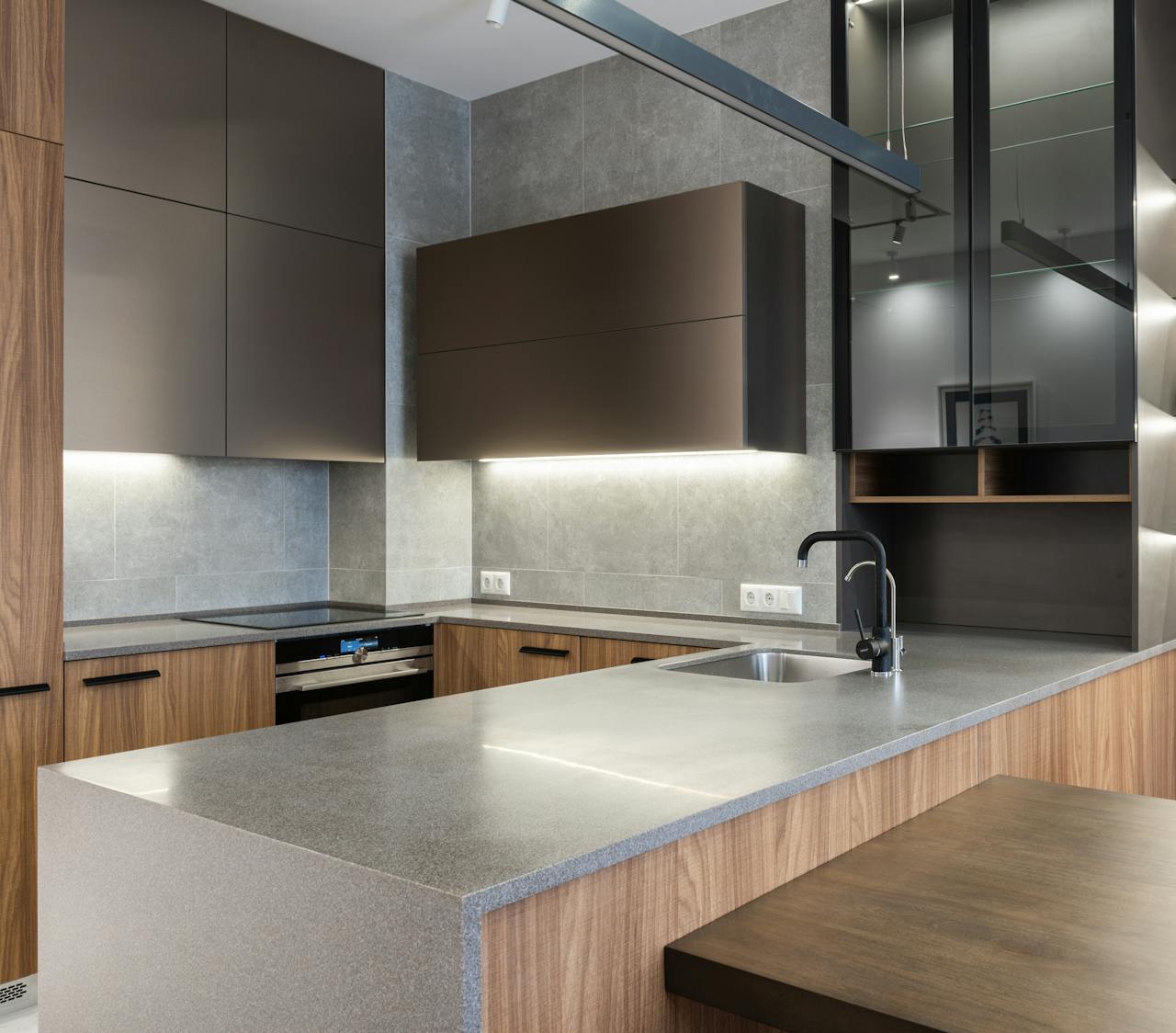
By extending the quartz over a long peninsula and using a quartz backsplash, the cool tone wrapped around the warm cabinets in a way that felt smooth and intentional.
I Positioned Cabinets Around the Quartz to Create Visual Flow
I placed warm cabinets:
- Above the main quartz counter
- Around the fridge
- Along the wall near the peninsula
This placement allowed the quartz to break up the warmth on every horizontal surface, preventing the cabinets from dominating the room.
I Avoided Overcrowding the Design
Because warm cabinets and cool quartz are contrasting, too many lines or details can create chaos.
To avoid this, I kept:
- Clean cabinet profiles
- Minimal visible hardware
- One quartz pattern throughout
- Balanced sightlines
The result was simplicity — and simplicity allowed the materials to shine.
Step 4: Choosing Hardware, Backsplash, and Lighting to Support the Balance
Hardware Became the Bridge Between Warm and Cool
Warm cabinets and cool quartz create visual contrast — hardware connects them.
I chose hardware with a:
- Brushed nickel finish
- Soft, cool undertone
- Subtle shine
This tied the quartz and cabinetry together beautifully.
The Backsplash Needed to Match the Undertone Story
A busy or warm backsplash would have ruined the balance. I needed something:
- Light
- Subtle
- Neutral
- Slightly cool
A soft quartz backsplash or a pale greige tile worked perfectly with both surfaces.
Lighting Was the Unsung Hero of the Entire Kitchen
Lighting is what ultimately made the warm–cool balance work.
I installed:
- Under-cabinet lighting
- Warm LED overhead lights
- Soft pendant lights above the peninsula
Warm lights enriched the cabinet finish.
Cool quartz reflected that warmth beautifully.
The entire room lit up evenly.
The Moment Everything Came Together: Installation Day
Seeing Warm and Cool Meet in Real Life Was Transformative
When the quartz slabs were installed, I immediately saw the balance I had worked so hard to create:
- The cabinets felt rich and grounded
- The quartz felt bright and refreshing
- The room felt cohesive and modern
- The contrast looked intentional — not accidental
The Kitchen Finally Looked Expansive
Cool quartz made the room feel bigger.
Warm cabinets made it feel cozy.
Together, they created the perfect blend of openness and comfort.
How the Balanced Design Improved My Daily Life
My Kitchen Became a More Enjoyable Place to Cook
The bright quartz made prepping easier.
The warm cabinets made the room feel welcoming.
Both worked together to improve workflow.
The Cleanliness Factor Improved Dramatically
Quartz made cleanup effortless.
Warm cabinets hid smudges better than stark-white cabinetry.
The Kitchen Became a Social Space Again
People naturally gravitated to the peninsula — the quartz surface became the focal point.
What I Learned From Balancing Warm Cabinets and Cool Quartz
Here are the most valuable lessons I learned:
1. Undertones matter — more than colour names.
Warm and cool can work together if undertones align.
2. Lighting changes everything.
Test samples during morning, afternoon, and evening.
3. Quartz is the perfect counterbalance to warm cabinetry.
It stabilizes the colour temperature of the room.
4. Warm cabinets make the kitchen feel inviting.
When paired correctly, they never feel outdated.
5. Balance doesn’t happen by accident — it’s designed.
Every element must support the warm–cool relationship.
Final Thoughts: Creating Warm–Cool Balance Was the Best Decision I Made in My Ottawa Kitchen
Achieving harmony between warm cabinets and cool quartz completely transformed my Ottawa kitchen. It gave me the bright, modern feel I wanted without sacrificing comfort or personality. The design feels intentional, calming, and timeless — a space that suits every season and every moment.
Balancing warm and cool tones isn’t just a design trend.
It’s a technique that brings life, dimension, and beauty to a kitchen.
And in my Ottawa home, it created the kitchen I had been imagining for years.